# Scheduled Billing

Scheduled Billing is one type of invoice from single billing. Scheduled Billing is used to schedule the delivery of invoices to customers.

## **Create New Scheduled Billing**

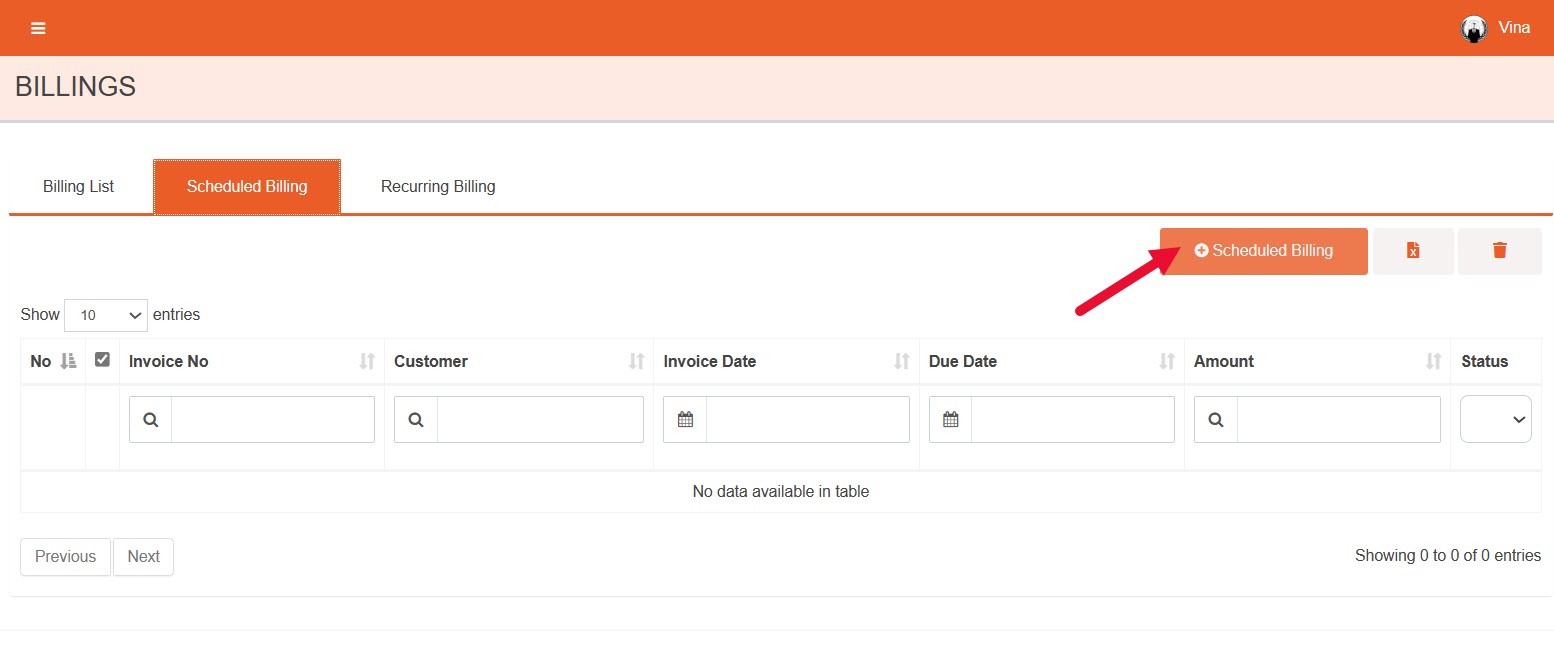
1. Select the Scheduled Billing menu on the Faspay Billing menu, and the Scheduled Billing menu page will be displayed. Click "**+ Scheduled Billing**" to add new invoice data.

<figure><img src="/files/q32ZeMAG58CJHQQRmLbg" alt=""><figcaption><p><strong>Create Scheduled Billing</strong></p></figcaption></figure>

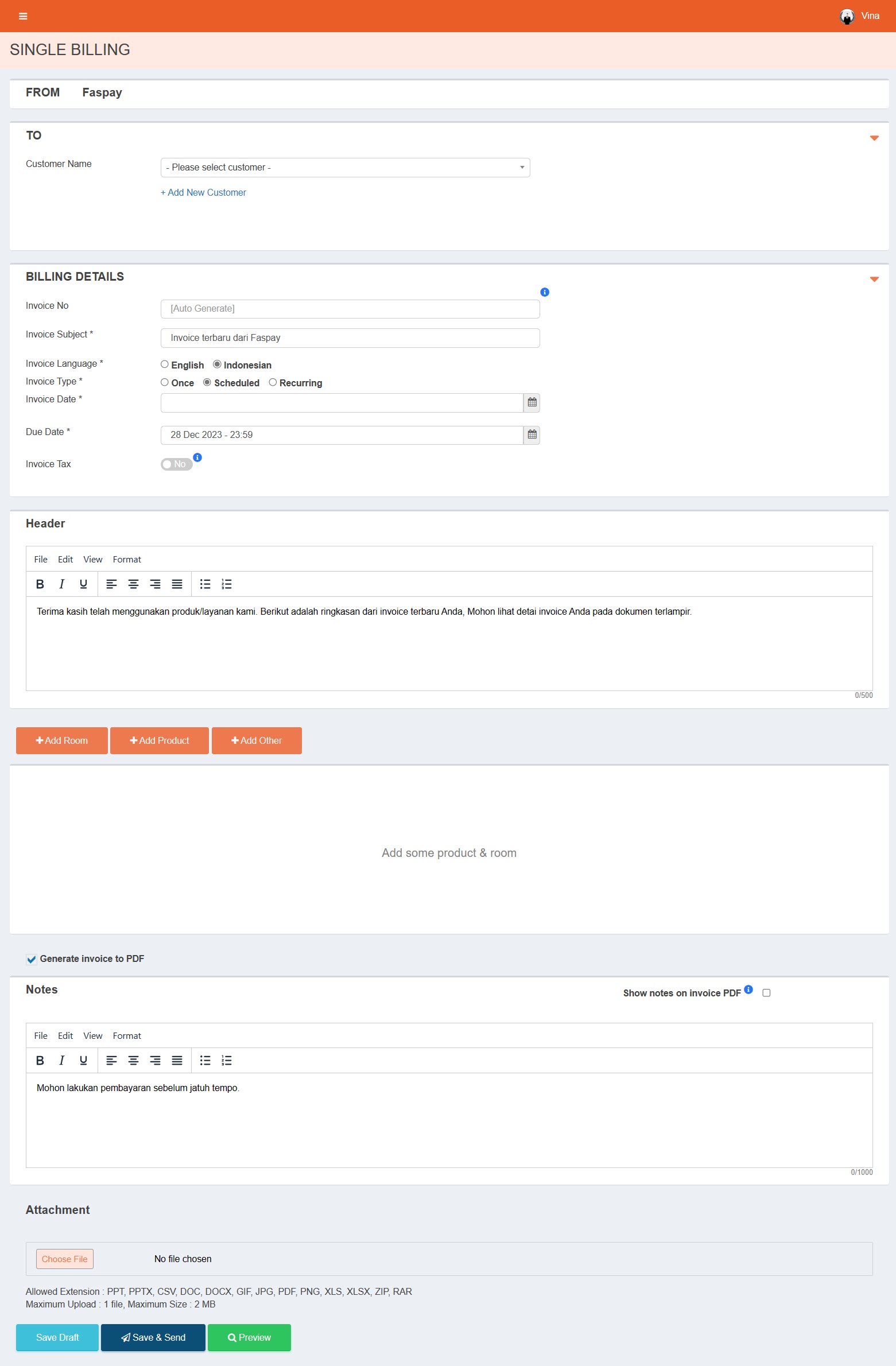
2. Next, will displayed Single Billing form.

<figure><img src="/files/LULF5IkadZM1GRGi14GI" alt=""><figcaption><p>New Scheduled Billing form</p></figcaption></figure>

**Field Parameter Single Billing form**

<table><thead><tr><th width="258">Field</th><th>Description</th></tr></thead><tbody><tr><td>To</td><td>Customer data</td></tr><tr><td>    Customer Name</td><td>Customer name (registered)</td></tr><tr><td>    Add New Customer</td><td>Add new customer data</td></tr><tr><td>Billing Details</td><td>Complete billing data</td></tr><tr><td>    Invoice No</td><td>Invoice number (auto generate)</td></tr><tr><td>    Invoice Subject</td><td>Invoice subject</td></tr><tr><td>    Invoice Language</td><td>Language used on the invoice</td></tr><tr><td>    Invoice Type</td><td>Invoice type (choose as needed)</td></tr><tr><td>    Invoice Date</td><td>Date the invoice was created</td></tr><tr><td>    Due Date</td><td>Payment limit/due invoice created</td></tr><tr><td>    Invoice Tax</td><td><p>Will appear if customer enable E-Faktur module.</p><p>If you activated the invoice tax, when system changes proforma to invoice, the system will automatically generate the tax invoice number for the invoice with the following conditions:</p><ul><li>The tax invoice number is taken from the range of tax invoice available numbers on the E-Faktur No page.</li><li>The system will use the tax invoice number sequentially from smallest to largest (Ascending order).</li><li>The period of the tax invoice number that was used must be the same as the current year(Year Period)</li></ul></td></tr><tr><td>     Transaction code</td><td><p>List of transaction code (will appear if customer activated Invoice Tax).</p><p>01: To Parties Who Are Not VAT Witholder</p><p>02: To the Treasurer's Witholder</p><p>03: To the Witholder except Treasurer's</p><p>04: DPP Other Values</p><p>06: Other submissions, including submission to foreign tourists in the context of VAT refunds</p><p>07: Submission of which VAT is not collected</p><p>08: Submission of VAT Exemption</p><p>09: Delivery of Assets (clause 16D of the VAT Law)</p></td></tr><tr><td>Header</td><td>Email header text</td></tr><tr><td>     Add Room</td><td>Choice of invoice type item type "room"</td></tr><tr><td>     Add Product</td><td>Choice of invoice type item type "product"</td></tr><tr><td>     Add Other</td><td>Choice of invoice types other than room &#x26; product</td></tr><tr><td>Generate Invoice to PDF</td><td>Information for generating invoices to PDF format</td></tr><tr><td>Notes</td><td>To add a note</td></tr><tr><td>Attachment</td><td>To attach a document</td></tr><tr><td>Button Option</td><td><ul><li>Click <strong>"Save Draft"</strong> to save the data temporarily.</li><li>Click <strong>"Save &#x26; Send"</strong> to save and send a new invoice.</li><li>Click <strong>"Preview"</strong> to preview the invoice before it is submitted.</li></ul></td></tr></tbody></table>

| <p><strong>Notes:</strong></p><ul><li>If the customer name is not yet available, then add new customer data by clicking <strong>"+Add New Customer"</strong> under the Customer Name field.</li><li>In the <strong>"Invoice No"</strong> field, if it is not filled in, it will be auto-generated (automatically filled with system numbering).</li><li>In the <strong>"Due Date"</strong> field, it cannot pass 1 day from the Invoce Date.</li><li>The <strong>"Add Room"</strong> feature is only available for Merchants of Hospitality type.</li></ul> |
| ----------------------------------------------------------------------------------------------------------------------------------------------------------------------------------------------------------------------------------------------------------------------------------------------------------------------------------------------------------------------------------------------------------------------------------------------------------------------------------------------------------------------------------------------------------- |

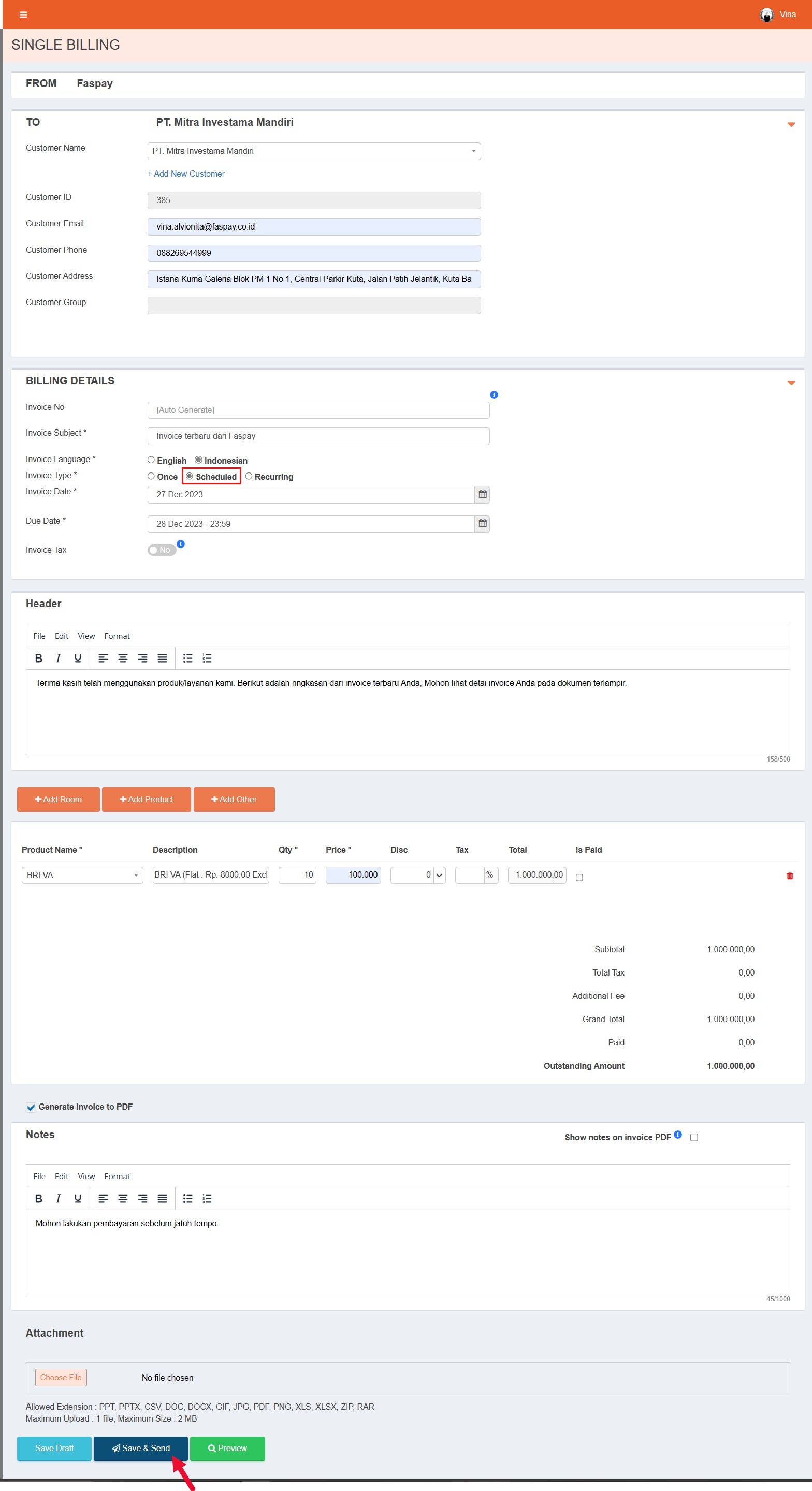
3. Input the Scheduled Billing data, then click **Save & Send.**

   **Notes:** Ensure that the invoice type is scheduled.

<figure><img src="/files/gIng8RWjbMfbSPYWOevE" alt=""><figcaption><p>inputting new Scheduled Billing data</p></figcaption></figure>

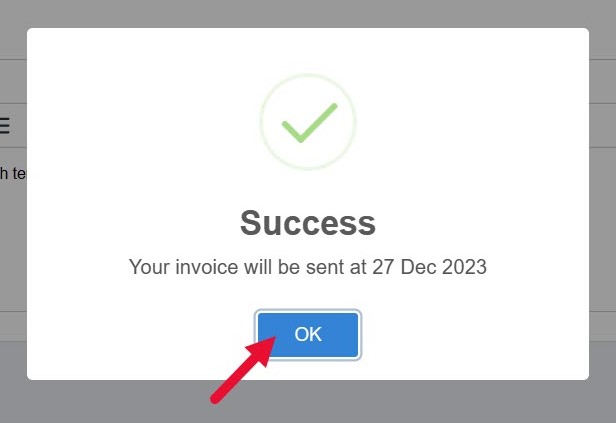
4. If the data is successfully submitted, it will display a success notification as follows, click **OK**. The invoice will be sent to customer's email as scheduled.

<figure><img src="/files/s4YXEK6fMwKmMFpkV4jq" alt="" width="308"><figcaption><p>Success Notification</p></figcaption></figure>

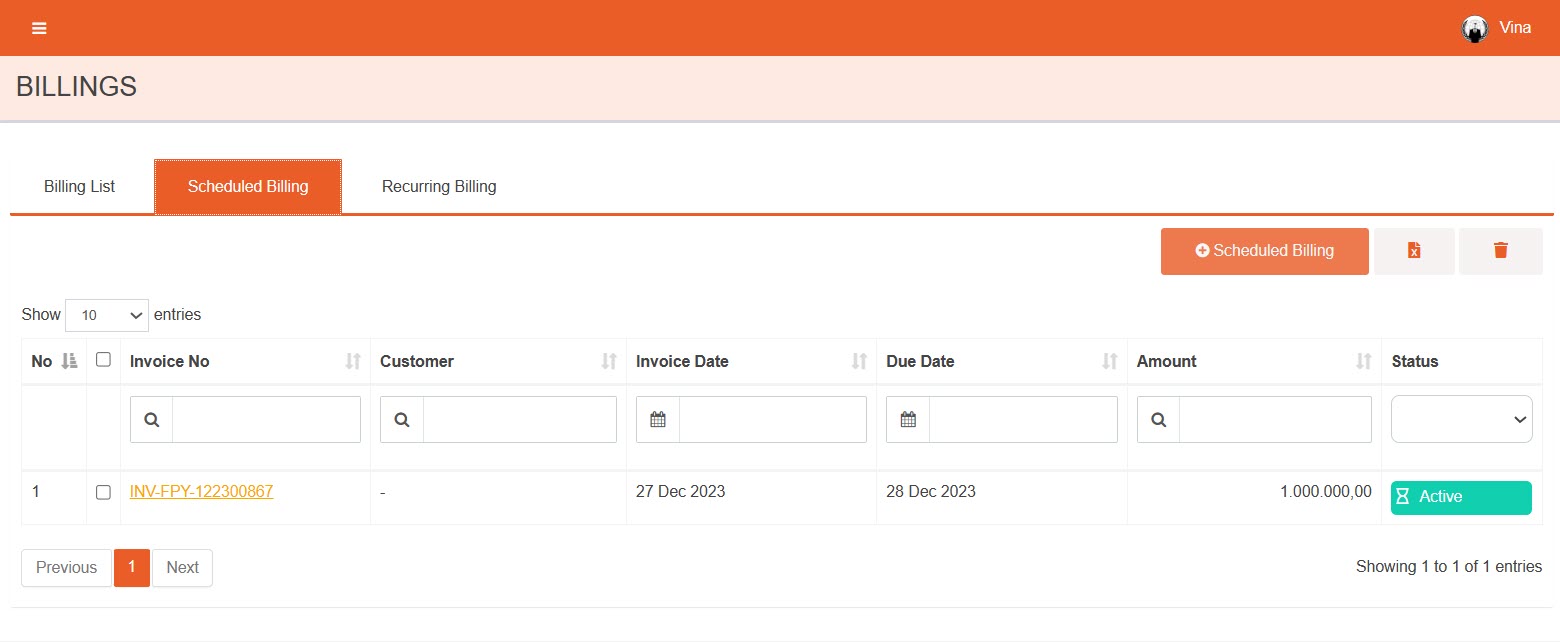
5. The Scheduled Billing will appear in the Scheduled Billing list.

<figure><img src="/files/QKQ85Vksp09Mw9cJpiqy" alt=""><figcaption><p>Scheduled Billing</p></figcaption></figure>

## **Search Invoice**

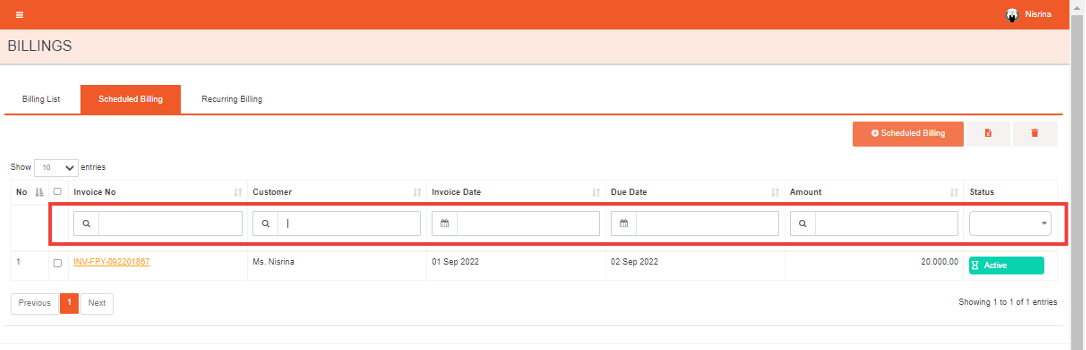
1. On the Scheduled Billing page to search data, it can be done by inputting the invoice data keyword in the search field.

<figure><img src="/files/gXO4d6upJUy2aKck8cQM" alt=""><figcaption><p>Scheduled Billing Search</p></figcaption></figure>

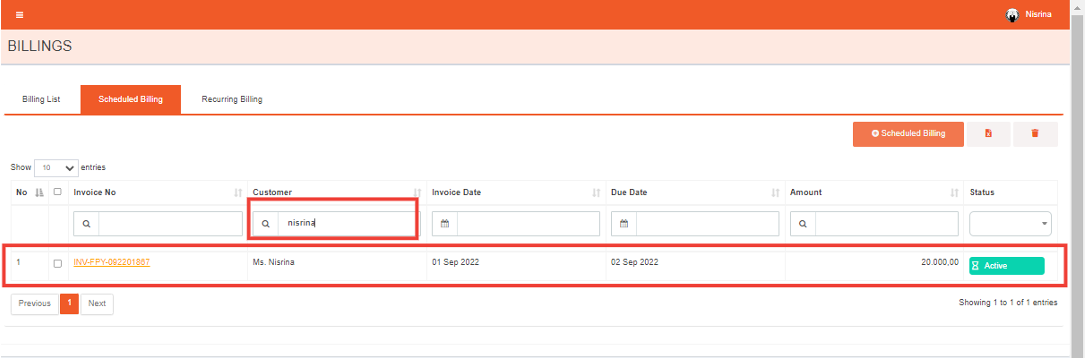
2. The search results like the following will be displayed.

<figure><img src="/files/1RU5kbORR9jPHZHxKH4s" alt=""><figcaption><p>Search Invoice Result</p></figcaption></figure>

&#x20;


---

# Agent Instructions: Querying This Documentation

If you need additional information that is not directly available in this page, you can query the documentation dynamically by asking a question.

Perform an HTTP GET request on the current page URL with the `ask` query parameter:

```
GET https://docs.faspay.co.id/getting-started/faspay-billing-2.0/how-to-use/billings/scheduled-billing.md?ask=<question>
```

The question should be specific, self-contained, and written in natural language.
The response will contain a direct answer to the question and relevant excerpts and sources from the documentation.

Use this mechanism when the answer is not explicitly present in the current page, you need clarification or additional context, or you want to retrieve related documentation sections.